


Barbadian youth advocates are drawing a line in the sand at the school gate, demanding that the government turn its 2023 School Nutrition Policy into binding law to shield children from predatory corporate marketing.
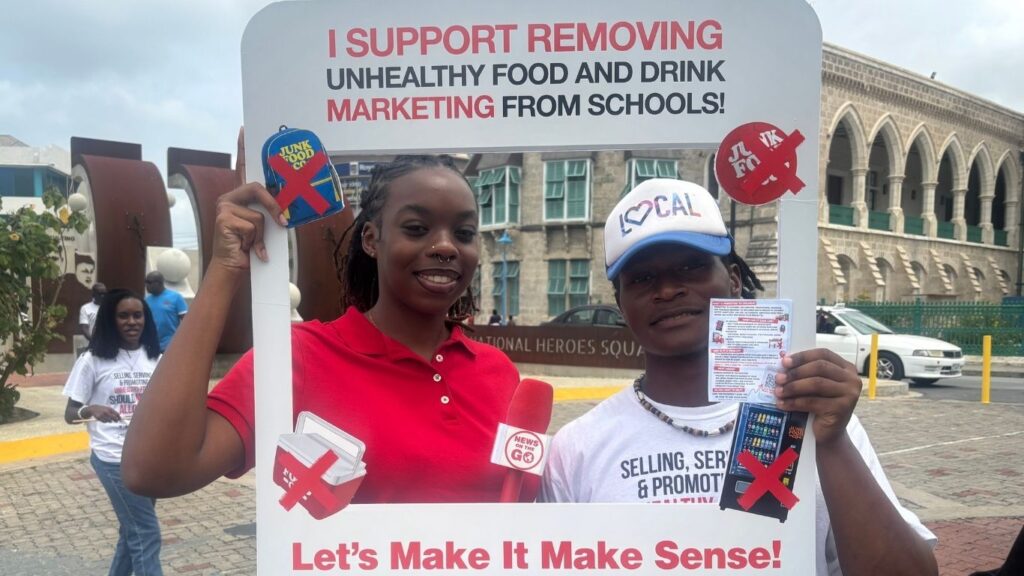
Gathering at National Heroes Square for the ‘Hope for the Future 3.0’ campaign, members of the Heart and Stroke Foundation of Barbados (HSFB) in collaboration with the Healthy Caribbean Coalition warned that commercial tactics are actively driving a surge in childhood obesity and early-onset non-communicable diseases (NCDs). By filling iconic public spaces with examples of the high-sugar, high-salt advertisements targeting local youth, the advocates made their message clear: schools must be safe zones for learning and development, not profit centers for big corporations.
Last Saturday, the youth advocates and members of the HSFB took their message directly to the public. Kabira Foster, Youth Health Advocacy Officer for the HSFB under the childhood obesity prevention program, shared that the sole purpose of the campaign is to push for the banning of unhealthy food and beverage marketing within Barbadian institutions.
“We are calling for strong legislation against the unhealthy marketing of foods and beverages in schools,” Foster expressed. “This is a major pillar in the School Nutrition policy. We want to make sure that our students are thriving in an environment that’s safe and healthy for them. We are seeing now more than ever our young people presenting with non-communicable diseases.”

In Heroes Square, the team set up a booth displaying various flyers used in unhealthy food and beverage marketing targeted toward children. Using their ‘Cool School Nutrition Tour’ as a platform, the advocates aim to educate students on the hidden sugar content in their daily snacks.
Timon Howard, a Human Nutrition student at UWI, stated that he believes students deserve an educational foundation free from the direct targeting and ploys of big corporations.
“We go into the schools and we talk to the children about how much sugar is supposed to be their limit for the day…6 teaspoons, 25 grams,” Howard explained. “However one snack pack, frutee…a lot of these have double, sometimes triple the amount of sugar that is supposed to be their limit for a day.”
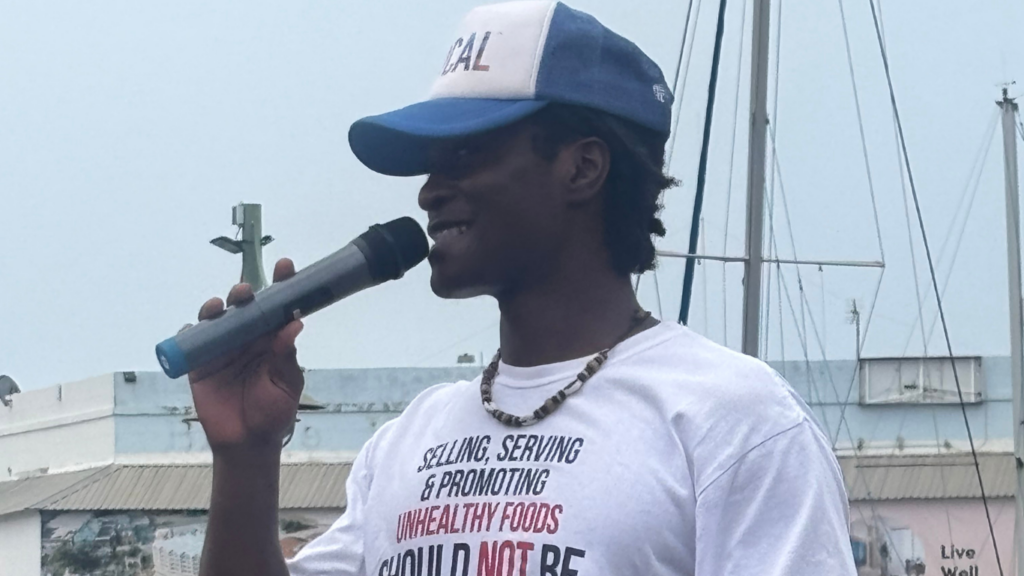
He mentioned that many students exceed the daily limit by having multiple unhealthy snacks. “Snacks, sweet drinks etc…have negative impacts which we see in high morbidity from NCD, non-communicable diseases. Cardiovascular diseases, hypertension, diabetes, strokes, cancer etc, which are exacerbated and the rate of morbidity is accelerated by these unhealthy lifestyles,” he stated. “They are becoming a ploy and money tactics by big corporations, who are advertising foods that aren’t good for them… It’s time for change.”
Meghan Modeste, a third-year medical student at UWI and speaker at the campaign, agreed that the current environment has a lifetime impact on the nation’s youth.

“This has a lifetime impact on the people we care about, these are our kids, not just a random person on the streets, these are our livelihood and the future of our nation. Schools should be environments where children go to learn, grow and undergo overall development,” Modeste said.
She noted that while children are taught to make good choices, the marketing they face is designed to bypass their judgment. “They only see the bright colours, the cartoon characters, celebrities on the packaging which are appealing to the eye, they just see fun. They do not see the underlying harm. It is our responsibility to let them know and to bring responsibility to our government to help our children shine.”
Although the National School Nutrition Policy was launched in 2023, the ‘Hope for the Future’ campaign is now advocating for the policy to be mandated as law to ensure schools remain free of predatory marketing.

“We are not trying to control anyone or dictate anyone’s meal… we are trying to preserve the livelihood of our children,” Modeste concluded.
Their aim is to ensure that children have enough nutrients that their learning and flourishing isn’t hindered. So that they can focus throughout the day, learn and have foundationally healthier habits and lifestyles, as their foundation will impact the trajectory of their lives and life choices.